
Give engineering teams clear APIs, events, integration patterns and test environments so they can focus on customer experiences instead of reverse-engineering financial infrastructure.
Composable. Core-agnostic. Deployment-flexible.
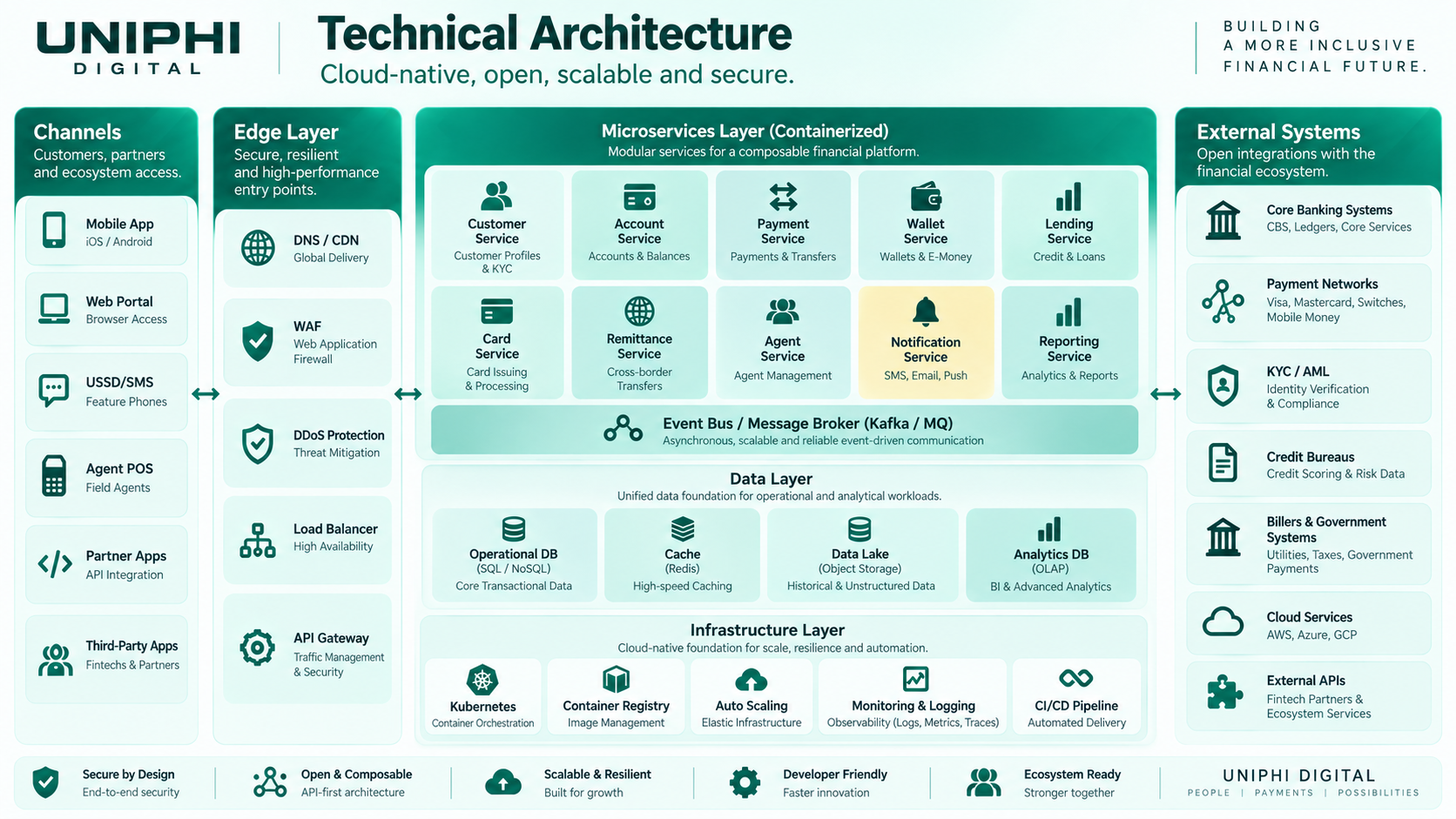
UNIPHI should show architecture as a product differentiator, not hide it behind a sales form.
Separate functional domains so modules can evolve independently and deployments can be scaled selectively.
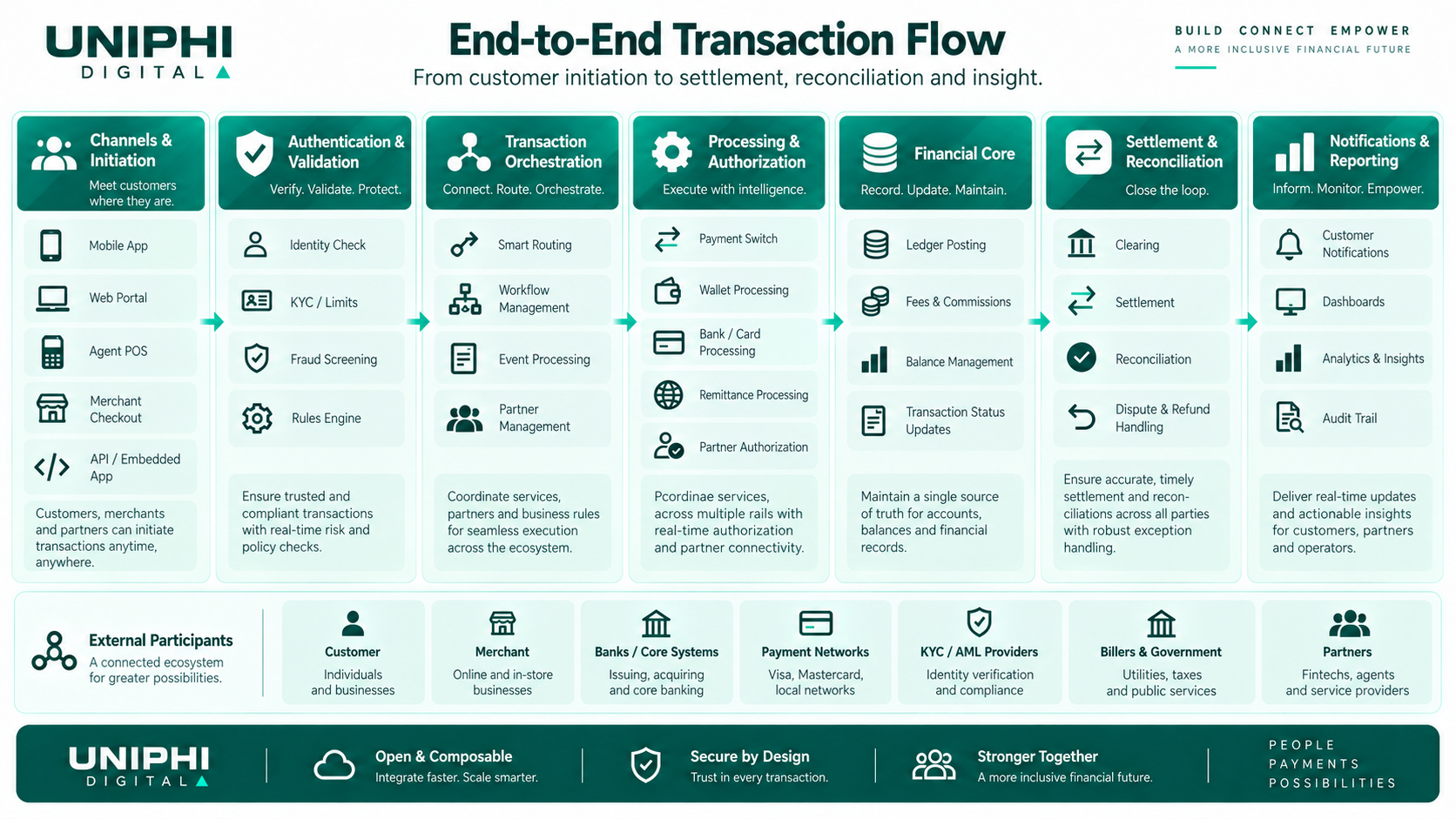
Use synchronous APIs for request/response interactions and events/webhooks for state changes and integrations.
Partition configuration and data according to brand, entity, market and regulatory requirements.
Cloud, private cloud, hybrid or on-premises patterns according to institution policy.
Metrics, logs, traces, transaction correlation and operational dashboards.
Redundancy, failover, queueing, idempotency and recovery controls designed around financial transaction integrity.
Position AI as an intelligence layer across the platform rather than a separate chatbot feature. Emphasize governed decisioning, operational automation and measurable financial outcomes.
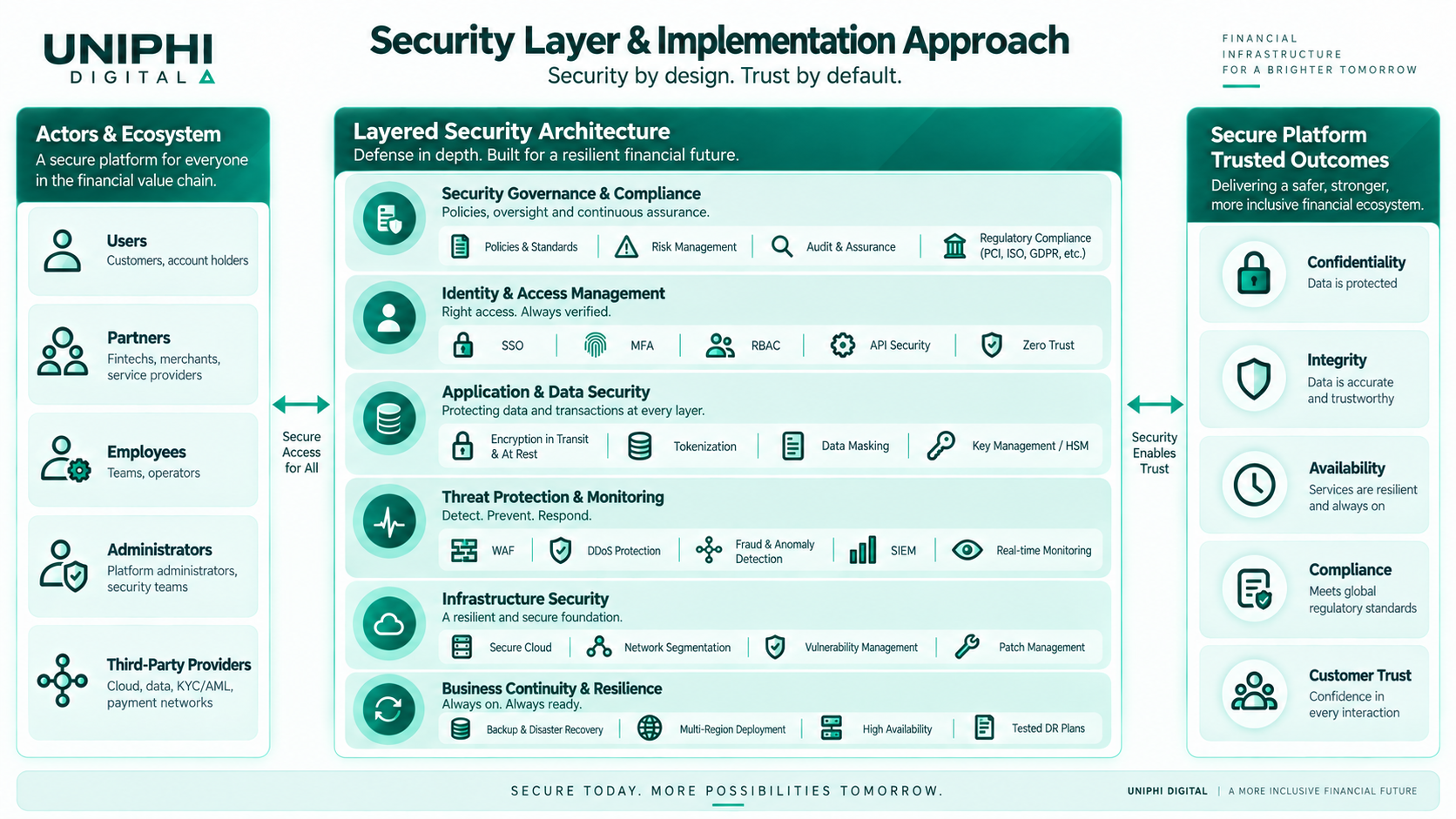
“Security designed into the financial stack.” Avoid claiming certifications or penetration-test outcomes unless
they are current, independently verifiable and applicable to the relevant product/deployment.
“Deploy anywhere. Operate with control, resilience and scale.”
UNIPHI supports flexible deployment models aligned to each institution’s infrastructure strategy, regulatory obligations, data-residency requirements and operational model. The platform can be deployed across public cloud, sovereign cloud, private cloud, hybrid environments or on-premise infrastructure.
Deploy on major hyperscaler environments where permitted, using cloud-native infrastructure, managed services and elastic scalability.
Support deployments where regulatory or data-residency requirements mandate hosting within a specific country or approved local cloud environment.
Deploy within institution-controlled cloud environments while retaining orchestration, automation and centralized operational controls.
Distribute platform components across cloud and on-premise infrastructure, allowing regulated data or legacy systems to remain local while digital services operate in the cloud.
Deploy within the institution’s own data centres for markets, institutions or regulatory environments requiring complete infrastructure control.
The Trust Center should become the enterprise proof layer for procurement, risk and security teams. Publish only evidence that is current and applicable.
ISO / quality / security certificates that are current and legally held by the relevant entity.
Clearly distinguish PCI DSS alignment, client deployment responsibilities and any certified scope.
Encryption, data residency, retention, access, backup and privacy controls.
SDLC, vulnerability management, code review, CI/CD, change control and dependency management.
VAPT approach, audit reports available under NDA, security questionnaires and evidence process.
Backup, disaster recovery, incident response and client-specific RTO/RPO commitments.




Keep Managed Services subordinate to the platform narrative. Position it as “Operate UNIPHI with the team that understands the platform,” not as a generic outsourcing service.
Adding {{itemName}} to cart
Added {{itemName}} to cart